Portable Recording · 2026-06-25
Best Portable Recorders for Electric Violinists and Content Creators
The best portable recorder for most electric violinists is the Zoom H4essential because it gives Tanya Strings the right balance of clean onboard stereo capture, two XLR/TRS inputs for a stage feed or mic pair, 32-bit float safety, and a small enough footprint for rehearsals, gigs, and travel content. If you want the cheapest useful option, buy the Zoom H1essential. If you want the fastest one-piece music recorder, choose the Zoom M2 MicTrak. Roland R-07 is the pocket rehearsal pick, H6essential is the expandable serious rig, and MixPre-3 II is the premium pro jump.
Follow Tanya Strings on Google
Add the site as a preferred source to see more new violin posts from Tanya Strings in Google.
Affiliate disclosure: Some links in this article are affiliate links. I may earn a commission if you make a purchase, at no extra cost to you.
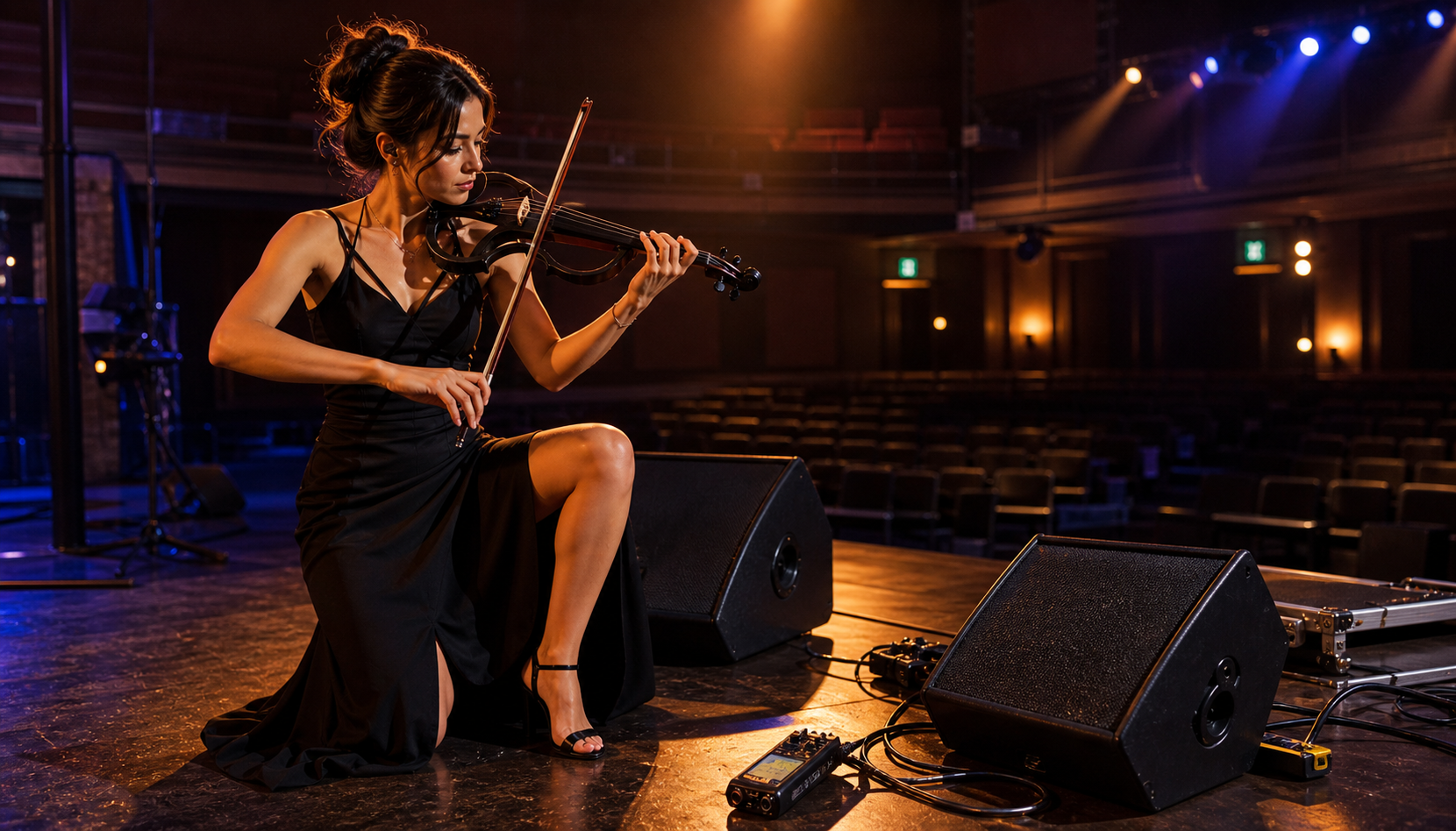
What is the best portable recorder for most electric violinists?
For most players, it is the Zoom H4essential. The reason is range. A portable recorder for electric violin has to do more than make a nice rehearsal memo. It needs to survive loud bow attacks, catch room sound without collapsing, accept a direct feed when the venue allows it, and still fit in a bag that already carries strings, batteries, and stage essentials. Zoom positions the H4essential around four-track 32-bit float recording, advanced X/Y mics, and two XLR/TRS inputs. That is the exact middle ground I trust most when the same tool has to work for rehearsal review, backstage content, and real-world performance capture.
My performer rule: a portable recorder should reduce friction, not create a second technical performance on top of the musical one.
Which portable recorders are worth buying right now?
This shortlist stays focused on electric violin reality: clip safety, useful stereo capture, bag-friendly size, battery logic, and whether the recorder still feels fast enough when I am moving between stage, rehearsal room, and content shoot.
| Product | Best for | Why Tanya would use it | Watch out for | Amazon link |
|---|---|---|---|---|
| Zoom H4essential | Most electric violinists who want one serious all-around recorder | I trust it when I need onboard stereo mics plus two real inputs for a venue feed, clip-safe capture, and a travel rig that still feels professional. | It is more tool than some casual users need, so buy it for real flexibility, not just because it is popular. | Check on Amazon |
| Zoom H1essential | Budget practice logs, quick reels, and simple travel capture | I would start here when I want the lightest low-stress way to document rehearsals, room tone, and performance ideas without opening a larger rig. | No XLR inputs and less control for ambitious stage workflows. | Check on Amazon |
| Zoom M2 MicTrak | Artists who want the cleanest one-piece stereo music recorder | I like it when I want better handling-noise control, stereo music focus, and a grab-and-record workflow for practice, busking, or clip filming. | It is not the box for adding venue XLR feeds or multiple external microphones. | Check on Amazon |
| Roland R-07 | Players who want a discreet pocket recorder with remote control | I would use it when I need pocket size, quick scene presets, and Bluetooth remote control for room recordings where I do not want to stand near the device. | It is compact and smart, but it does not offer the input flexibility of the larger Zoom or Sound Devices options. | Check on Amazon |
| Zoom H6essential | Serious mobile rigs that need more inputs and upgrade room | I would step up here when mobile recording is part of the job and I need four XLR/TRS inputs, interchangeable capsules, and a recorder that can scale with bigger projects. | Larger footprint and higher cost than the simpler capture-first options. | Check on Amazon |
| Sound Devices MixPre-3 II | Premium paid-work capture, films, and the cleanest mobile preamps | I would choose it when one missed take is expensive and I need stronger preamps, serious limiters, and cleaner multi-input control than consumer recorders usually give. | It is the premium spend on the list and makes sense only if your mobile recording needs are already demanding. | Check on Amazon |
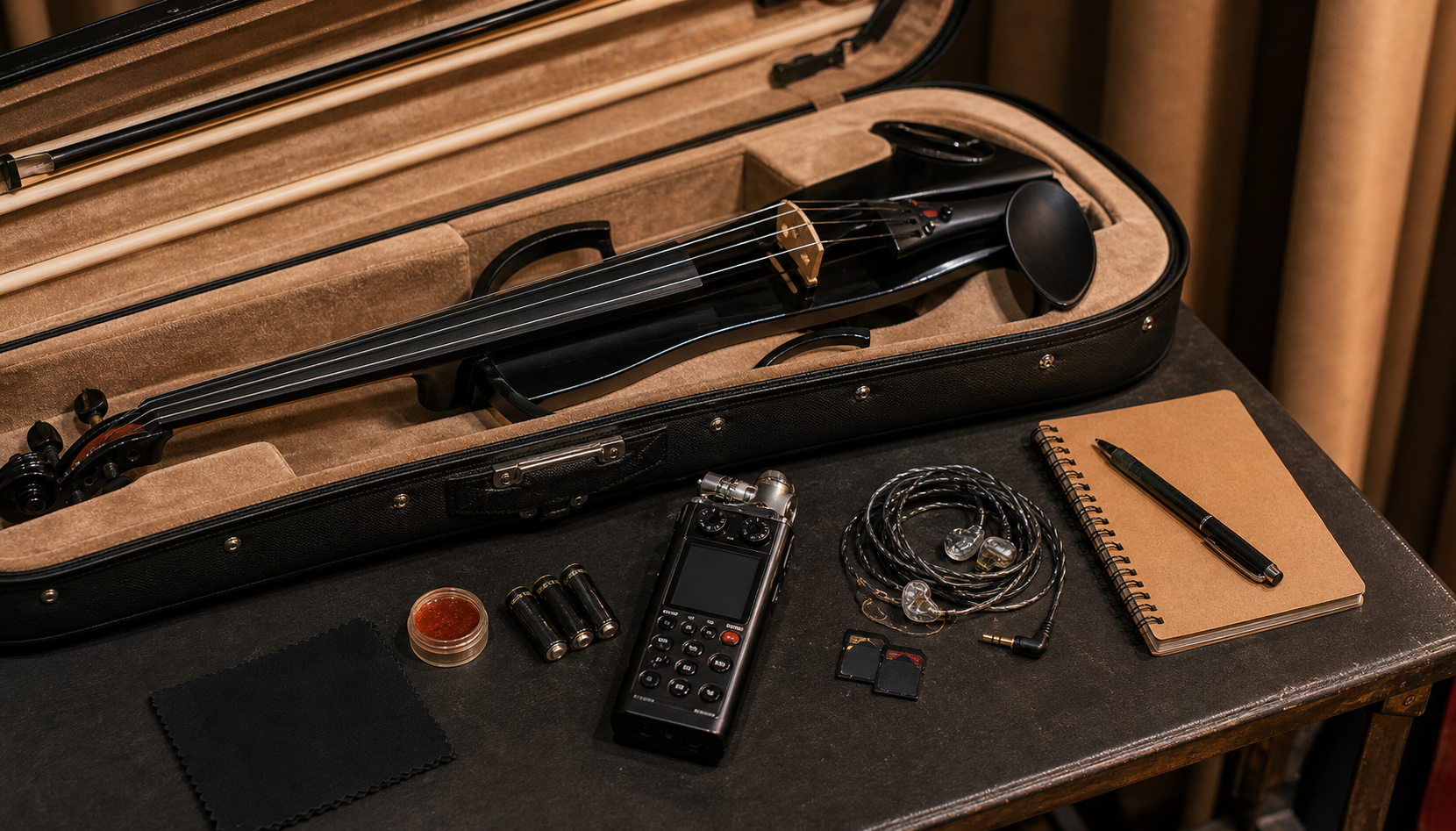
Why is the H4essential the safest all-around pick?
The H4essential lands in the sweet spot because it does enough without becoming a burden. Zoom says it gives you four tracks, 32-bit float recording, advanced X/Y mics, and two XLR/TRS inputs. It can also work as a 4-in/2-out USB interface and handle loud sources with onboard mics rated up to 130 dB SPL. That matters to Tanya Strings because the same recorder can catch a solo room performance, accept a board feed at a venue, record a direct source and ambience together, and still behave like a sensible travel tool.
Who should buy the H4essential first?
I would buy it first if I want one recorder that can move between practice review, stage capture, and content production without forcing me into a separate recorder for each job.
- Pros: strong all-around feature set, two real inputs, onboard stereo mics, 32-bit float confidence, and practical travel size.
- Cons: more expensive than a simple memo recorder and more device than ultra-casual users may need.
See the official Zoom H4essential page · Find H4essential options on Amazon
When is the H1essential the smartest budget buy?
The H1essential is smarter when the real goal is speed and consistency at the lowest useful cost. Zoom frames it as the easiest recorder in the line, built around one-button 32-bit float capture for musicians, filmmakers, podcasters, and content creators. For electric violin, that makes sense when I mainly need clean rehearsal references, quick hotel-room ideas, lesson-free self-review, or better audio for simple vertical clips than a phone usually gives me. It is not the box for complex stage routing. It is the box for actually pressing record often.
Who should start with the H1essential instead of moving straight to H4essential?
I would start here if I do not need XLR inputs yet and I mainly want a compact practice-and-content recorder that removes excuses instead of adding setup time.
- Pros: low cost, tiny footprint, 32-bit float ease, and a fast habit-building workflow.
- Cons: no XLR inputs and less room to grow when stage capture becomes more serious.
See the official Zoom H1essential page · Find H1essential options on Amazon
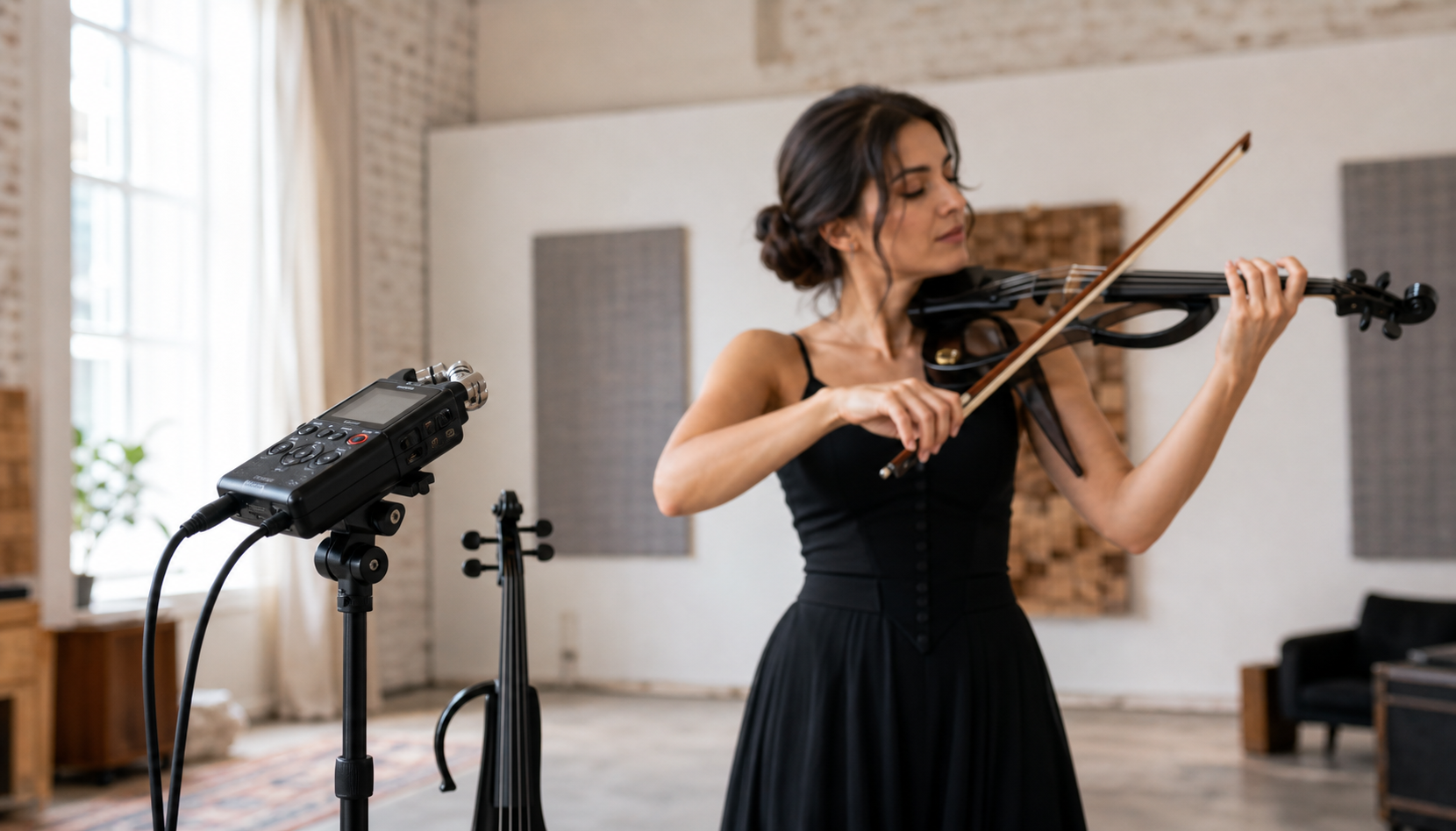
Why would Tanya choose the M2 MicTrak instead of a standard handy recorder?
The M2 MicTrak becomes attractive when I want the fastest grab-and-go music recorder with better handling-noise discipline than a lot of general-use devices. Zoom describes it as a stereo 32-bit float recorder with newly designed X/Y microphones, reduced handling noise, stereo and mono modes, and USB mic use on computers and mobile devices. That is a strong electric violin story because sometimes I do not want a multi-input production box. I want one recorder that can live on a stand, catch a busking set, or document a performance take without me thinking about gain or extra routing.
What makes the M2 especially good for music-first capture?
Its whole design is about one-piece stereo recording. If my focus is bow detail, room feel, and quick musical review rather than external-input flexibility, that simplicity is a real advantage.
- Pros: music-first stereo design, 32-bit float simplicity, low handling noise, and easy USB use for streaming or quick uploads.
- Cons: less flexible than H4essential or H6essential for direct feeds and external microphones.
See the official Zoom M2 MicTrak page · Find M2 MicTrak options on Amazon
When does the Roland R-07 make more sense than a larger recorder?
The R-07 makes more sense when I want discretion and remote control more than bigger input counts. Roland positions it as a go-anywhere high-resolution recorder that fits in a pocket, uses scene presets, and supports Bluetooth remote control and monitoring. That is useful for electric violin players who want to hide the recorder deeper in a room, control it from a phone, or keep the setup subtle in rehearsals, acoustic venue checks, and backstage content situations. It is a smart recorder when visible gear would interrupt the flow.
Who should buy the R-07 first?
I would buy it if I want a pocket recorder for room sound, remote placement, and discreet rehearsals where a larger handheld or multi-input unit would feel excessive.
- Pros: pocket size, scene memory, Bluetooth remote workflow, and clean low-friction placement options.
- Cons: not the strongest choice when I need XLR inputs or more ambitious multi-source capture.
See the official Roland R-07 page · Find R-07 options on Amazon
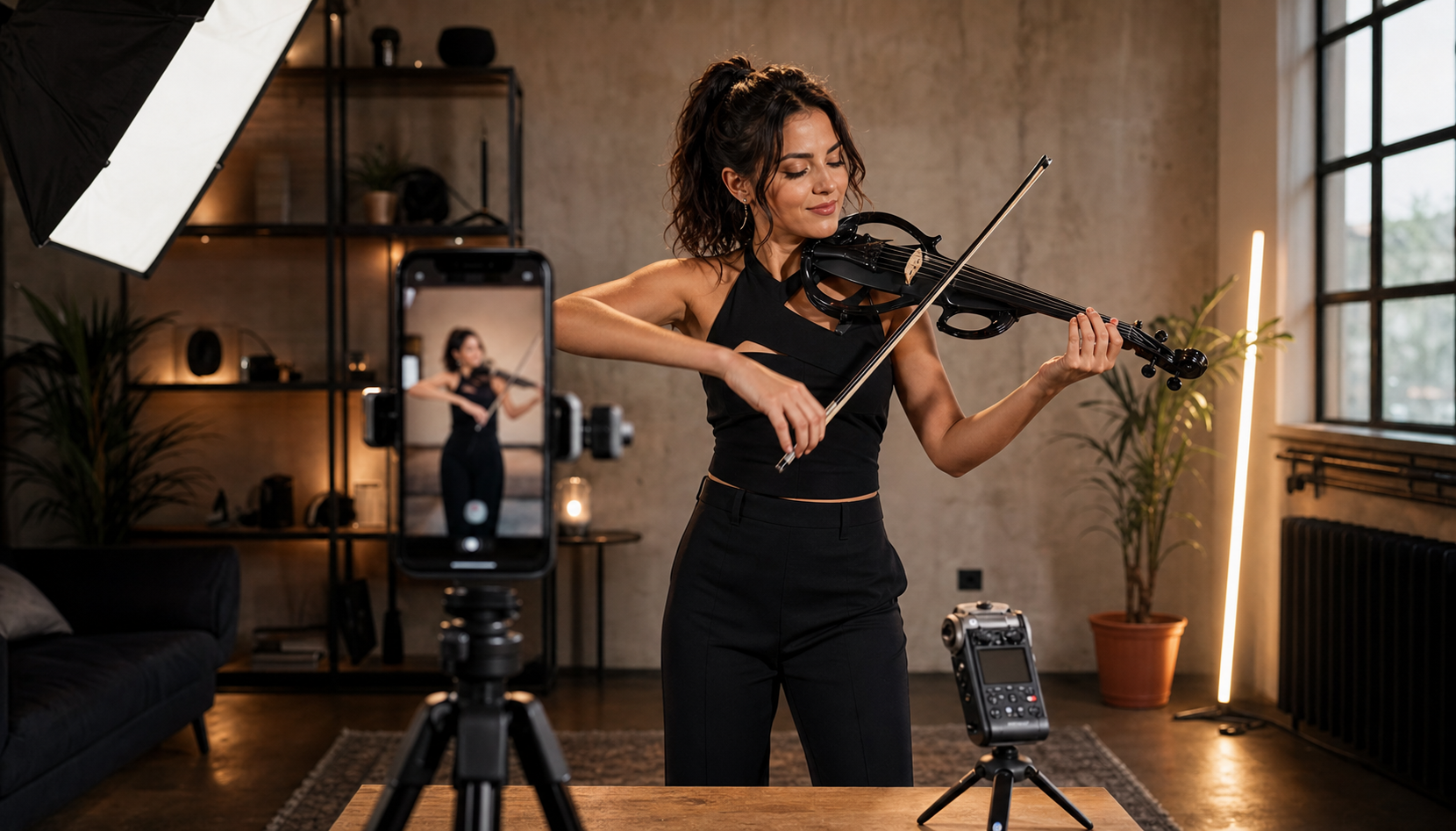
Who should step up to the H6essential or MixPre-3 II?
These are the mobile-upgrade recorders. I stop thinking about casual capture and start thinking about paid output, multi-source sessions, and work where bad audio wastes real opportunity.
Why would Tanya move to H6essential?
Zoom says the H6essential gives six tracks of 32-bit float recording, four XLR/TRS combo inputs, interchangeable microphone capsules, and 32-bit float interface mode while recording to SD at the same time. That matters when I need more than one external source, when I want to capture both room and direct signals with more control, or when portable recording is becoming part of the business rather than a casual add-on.
- H6essential pros: more inputs, larger expansion path, interchangeable capsules, and a stronger fit for more ambitious mobile sessions.
- H6essential cons: larger bag footprint and more cost than most solo violinists need every day.
See the official Zoom H6essential page · Find H6essential options on Amazon
When is MixPre-3 II the smarter premium move?
MixPre-3 II is smarter when the standard has already moved past consumer-grade convenience. Sound Devices lists 32-bit precision ADC, very high dynamic range, three mic-line inputs plus auxiliary inputs, adjustable low-cut filters, and multi-stage limiters. I reach for that level when the recorder has to support serious mobile audio, film-adjacent work, or premium content sessions where cleaner preamps and more dependable control really pay off.
- MixPre-3 II pros: premium preamps, pro-level control, stronger protection against ruined takes, and a better fit for demanding paid workflows.
- MixPre-3 II cons: highest price here and unnecessary for simple rehearsal capture.
See the official Sound Devices MixPre-3 II page · Find MixPre-3 II options on Amazon
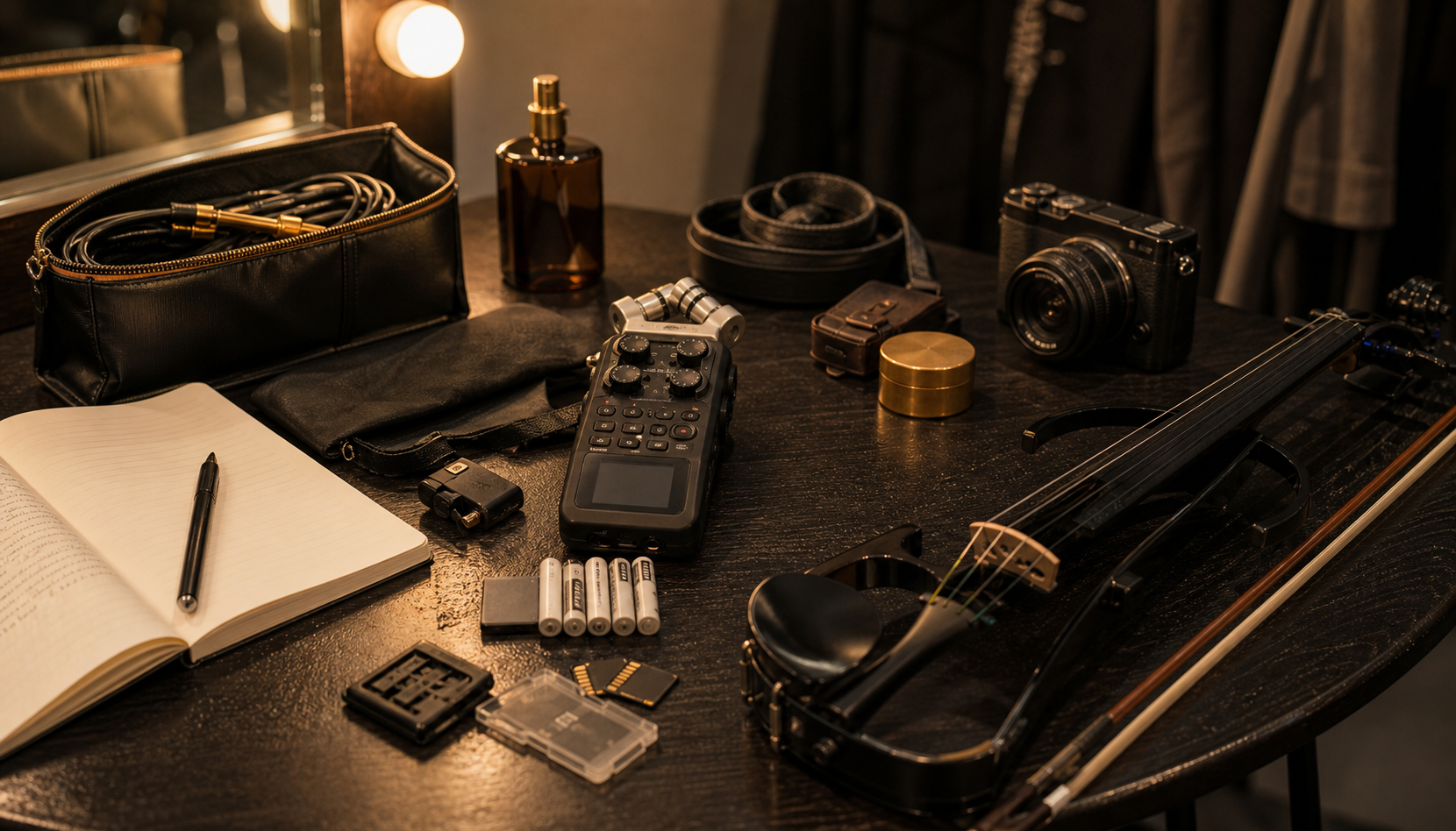
What should you buy first if your budget is limited?
If money is tight, I would buy in this order:
- Buy the habit builder first: if you are not recording yourself often, H1essential is the easiest entry point.
- Buy the all-around tool next: step to H4essential when you need external inputs, venue feeds, or more serious capture options.
- Buy the premium upgrade last: only move to H6essential or MixPre-3 II after mobile recording is already affecting paid work, releases, or frequent content output.
I would rather hear a steady stream of useful rehearsal and gig recordings from a modest recorder than own a premium box that stays home because it feels like too much work to carry.
What matters most when choosing a portable recorder for electric violin?
Electric violin tells on weak recording choices quickly. Bow transients, upper mids, and room reflections all expose bad decisions fast, so my checklist stays short.
- Protect clip safety: loud attacks and sudden accents are normal on stage, so overload protection matters.
- Match the job to the input count: not every recorder needs XLR inputs, but the wrong limitation becomes obvious on the wrong gig.
- Keep the size honest: the recorder that actually travels wins over the one with better specs that stays in a drawer.
- Think about placement: pocket, stand, tripod, or backstage shelf all change what kind of recorder makes sense.
- Respect the editing chain: the best recorder is the one that produces files you will actually review, cut, and publish.
How does Tanya Strings capture rehearsals, gigs, and content without ruining the performance flow?
I keep the system simple because the recorder is there to support the art, not to become the center of attention. For a world-class electric violin performer and content creator, mobile audio only helps when it stays repeatable.
- Choose one capture goal before the show: room sound, direct feed, ambience, or content audio. I do not improvise the purpose after setup.
- Place the recorder early: I would rather make a calm placement decision before doors than chase a perfect angle during the first song.
- Carry a battery and card routine: portable audio fails more often from tired logistics than from weak microphones.
- Review fast, not eventually: the value appears when I listen back soon enough to improve the next rehearsal, clip, or stage plan.
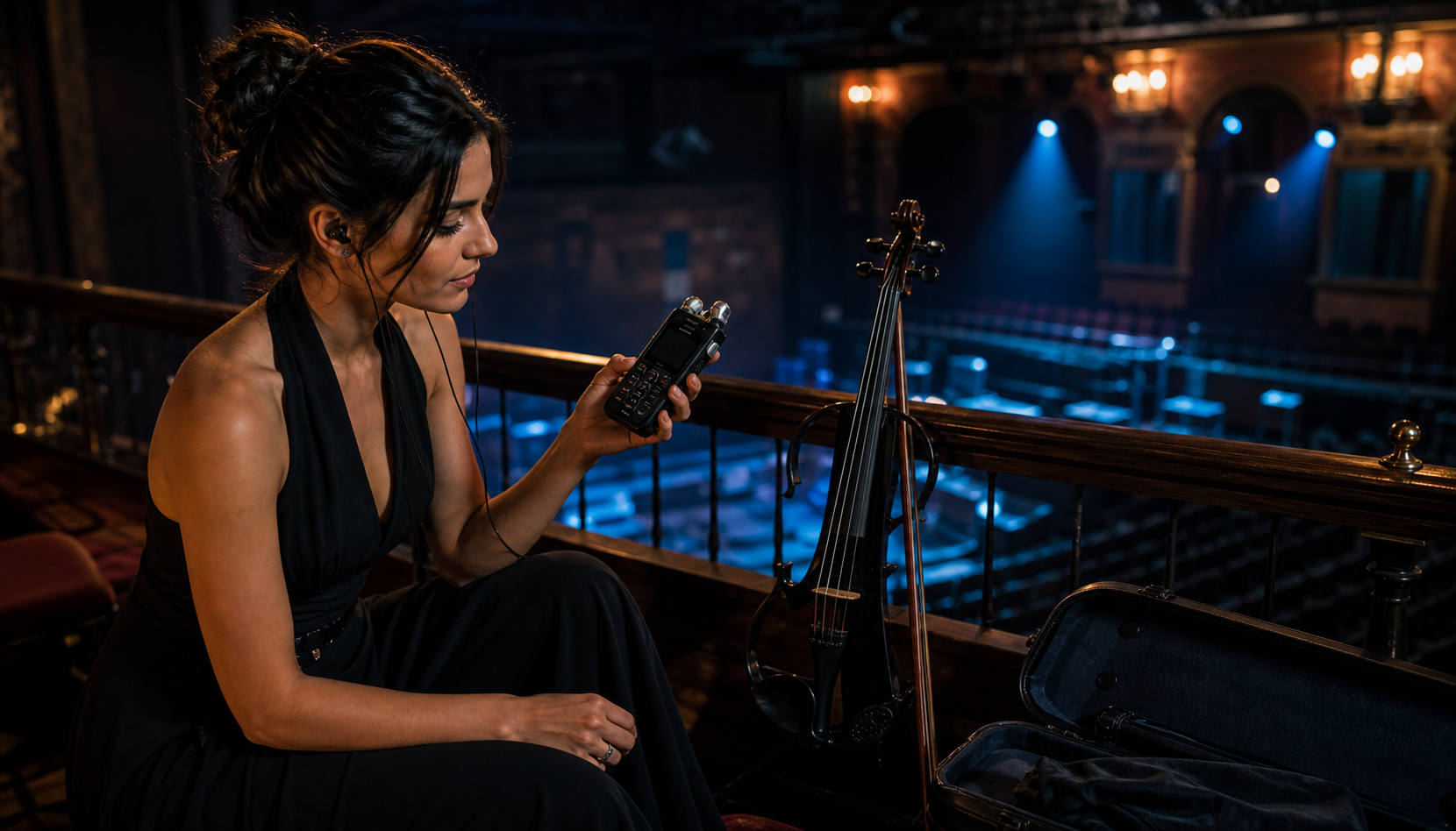
That is how Tanya Strings treats portable recorders: not as gadgets, but as quiet working tools that protect ideas, document progress, and give great performances a second life online.
FAQ
What is the best portable recorder for most electric violinists?
For most players, the Zoom H4essential is the safest overall buy because it combines portable stereo capture, two XLR/TRS inputs, 32-bit float safety, and a size that still makes sense for real travel.
Is a portable recorder better than a phone for electric violin?
Usually yes, because a dedicated recorder handles loud dynamics more safely, stays separate from phone interruptions, and gives you microphones and controls built for audio first.
Should I buy H1essential or H4essential first?
Buy H1essential first if you mainly need low-cost stereo practice capture. Buy H4essential first if you already want a recorder that can handle mics, board feeds, and more serious gig or content work.
When is MixPre-3 II worth the extra money?
It is worth the jump when mobile recording quality affects paid work, higher-stakes releases, or professional content jobs where cleaner preamps and better control are not optional.