News · 2026-07-22
Violin News Roundup: Premium Recital Formats, Rising Duos, and Camera-Ready Chamber Music
As of Wednesday, July 22, 2026, one of the clearest violin stories is not a giant concerto headline. It is the way summer presenters are selling smaller, sharper violin formats as destination experiences. Ravinia has Augustin Hadelich carrying a full solo evening tonight, Aspen is pairing Maria Duenas with Eric Lu for a rising-star duo recital on July 23, Music Academy of the West is giving Jennifer Koh a Bach-to-Mazzoli statement night on July 25, and Seattle Chamber Music Society is wrapping violin-heavy programming inside a camera-smart digital product. For performers, planners, and music fans, intimacy is being packaged as premium, not secondary.
Follow Tanya Strings on Google
Add the site as a preferred source to see more new violin posts from Tanya Strings in Google.
Why is Ravinia treating a solo violin night like a destination event?
Because the presentation says the instrument itself is enough to anchor the evening. Ravinia's official page places Augustin Hadelich in the Martin Theatre on Wednesday, July 22 with tickets from $17 to $66, while also letting ticket holders use the Lawn and hear a live audio feed outside. The program is unusually focused and confident: Telemann, two Coleridge-Taylor Perkinson solo works, Ysaye, Paganini, and Bach's Partita No. 2 in D minor. That matters because presenters do not program evenings like this unless they believe an audience will follow a violinist through contrast, stamina, and long-form listening, not just through name recognition.
Tanya's performer take: when a festival trusts solo violin to hold both the room and the broader grounds experience, the instrument stops being decorative and starts acting like the headline brand.
What does Aspen gain by putting Maria Duenas and Eric Lu together right now?
A sharper signal about future star power. Aspen's July 23 listing for Maria Duenas and Eric Lu at Harris Concert Hall frames the recital as a meeting between the 2021 Menuhin Competition winner and the 2025 International Chopin Competition winner. The repertoire is not filler. It is Schubert's "Grand Duo," Mozart's K. 304, and Brahms's Third Sonata, a sequence that demands real pacing, color control, and partnership. For a festival audience, that is a strong value proposition: two fast-rising artists, one intimate hall, and a program that rewards listening rather than spectacle.
Tanya's performer take: duo recital work still reveals more about an artist than a flashy clip does. You hear timing, breathing, and whether two musicians can create tension without hiding behind production.
Why does Jennifer Koh's Bach, Glass, and Mazzoli arc matter beyond one recital?
Because it is a clean example of identity through programming. The official page for Jennifer Koh's "Bach & Beyond" recital on Saturday, July 25 puts Bach's A minor Sonata and D minor Partita around Philip Glass's Sarabande in Common Time and three Missy Mazzoli works, all in Santa Barbara's Lobero Theatre. The page also notes Koh's long record of commissioning and premiering new music. That is important for today's violin field because it shows how a recital can feel modern without abandoning seriousness. This is not crossover by costume. It is a violinist using repertoire architecture to tell the audience what kind of artistic mind is on stage.
Tanya's performer take: for electric violinists and content creators, the lesson is simple: strong positioning does not come from mixing genres randomly. It comes from making your sequence feel inevitable once the first note lands.
How is Seattle Chamber Music Society turning violin-heavy chamber music into a camera-ready product?
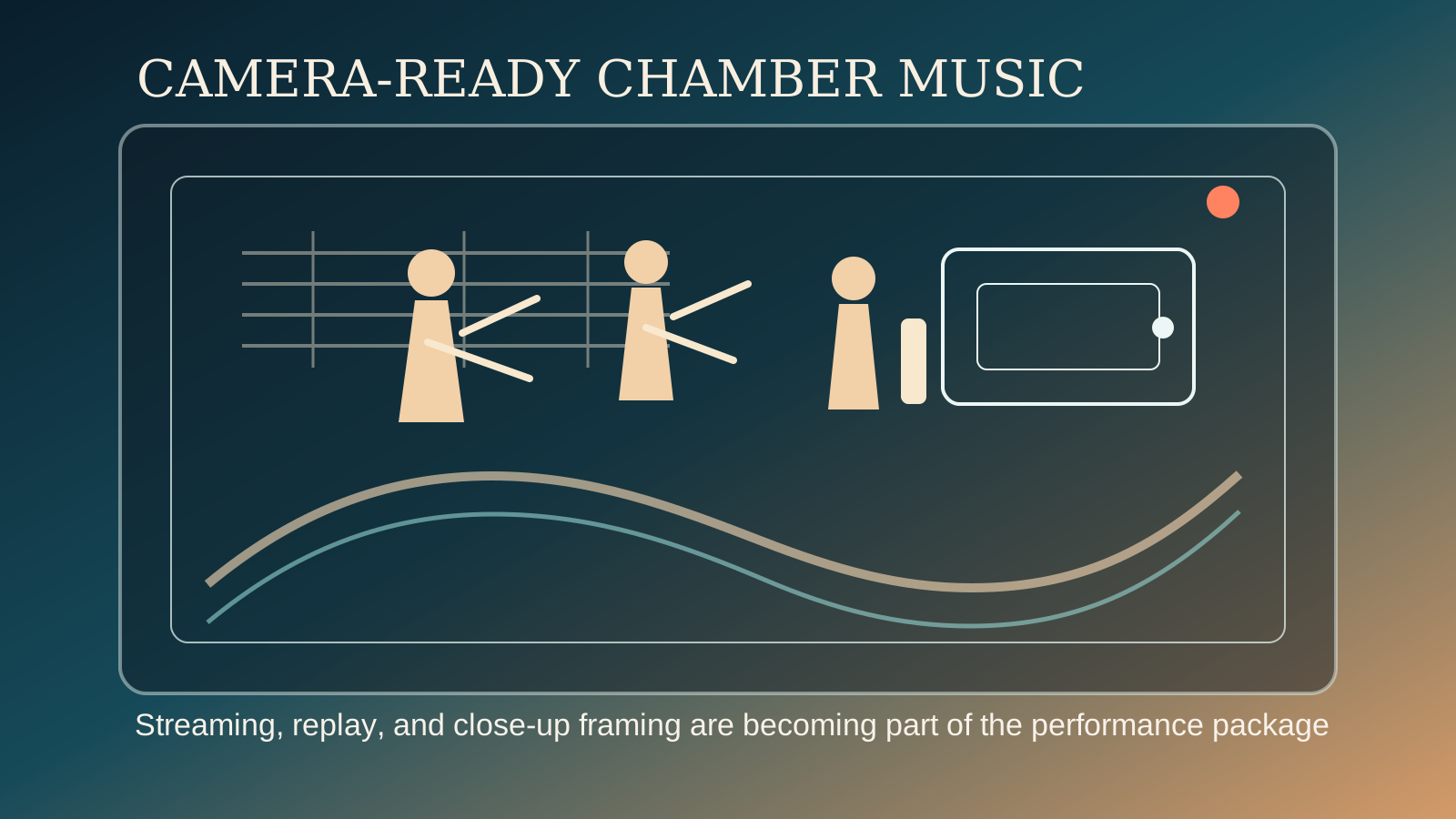
By treating digital access as part of the ticketed offer, not as an afterthought. SCMS is selling virtual tickets for its July 24 Summer Festival Concert #8, where Karen Gomyo leads Piazzolla's Histoire du Tango, James Ehnes joins John Adams's Shaker Loops, and Erin Keefe appears in Schubert's B-flat Piano Trio. On top of that, the organization's Virtual Concert Hall page promises six HD camera angles, behind-the-scenes material, live intermission interviews, and a 24-hour replay window before longer on-demand access arrives. For violinists and planners, that is not just a streaming convenience. It is a different kind of audience design, one built around close-up detail, repeat viewing, and a more legible sense of personality.
Tanya's performer take: camera-aware classical packaging is now performance infrastructure. If your hands, bow changes, and stage communication read well on screen, the digital layer becomes a force multiplier instead of a compromise.
What should violinists, planners, and fans watch next?
- Watch which festivals keep giving violin-led recitals premium rooms and premium framing, because that signals long-term audience confidence.
- Notice when presenters pair young top-tier artists in duo formats, not only in competitions or gala cameos.
- Track programming that moves cleanly from core repertoire into living composers without sounding apologetic about either side.
- Take the camera layer seriously: replay, close-up framing, and backstage context are increasingly part of how violin performance is consumed and remembered.