News · 2026-07-28
Violin News Roundup: Livestream Rooms, Competition Architecture, Crossover Touring, and Stage Talkback
As of Tuesday, July 28, 2026, the useful violin story is not one celebrity recital but the way the scene is being packaged for several audiences at once. Music@Menlo has a July 28 concert with a paid livestream and a free July 29 Jessica Lee violin master class. The International Violin Competition of Indianapolis is already showing its September 17 to October 4 venue map and Jessie Montgomery commission in public view. David Garrett is days away from a new open-air crossover run, while Sennheiser has added a sharper talkback and monitoring workflow for live crews.
Follow Tanya Strings on Google
Add the site as a preferred source to see more new violin posts from Tanya Strings in Google.
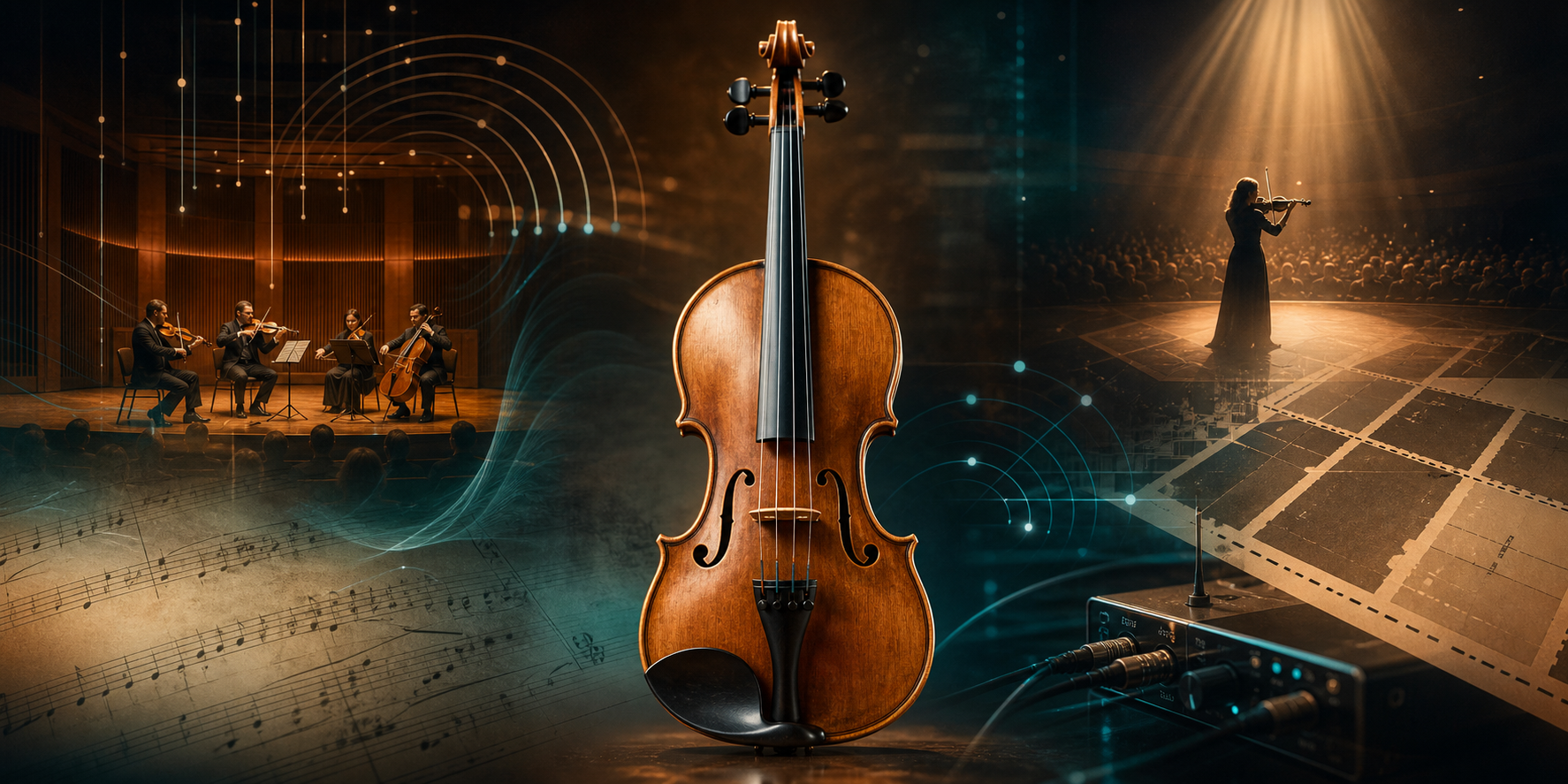
Why does Music@Menlo's July 28 to 29 access stack matter?
Because it treats violin performance, violin process, and paid digital access as one coherent product. On the official page for Concert Program IV: The Unfolding of Music, Music@Menlo places tonight's July 28 concert beside a purchasable livestream and frames the program as a historical arc from Telemann to the West Coast premiere of Sir Stephen Hough's Piano Quintet, Les Noces Rouges. The casting is violin-heavy, with Aaron Boyd, Stella Chen, Jessica Lee, and Arnaud Sussmann all on the page. Then the festival turns immediately to the public learning layer. Its July 29 Jessica Lee master class is listed as free, no reservation required, and paired with a livestream link. That is a strong signal about audience behavior: some listeners still want the polished evening concert, while others want the room where interpretation gets tested in daylight.
Tanya's performer take: this is exactly the kind of model serious violinists should study. A world-class performance brand is stronger when the concert, the camera, and the teaching room reinforce each other instead of competing for attention.
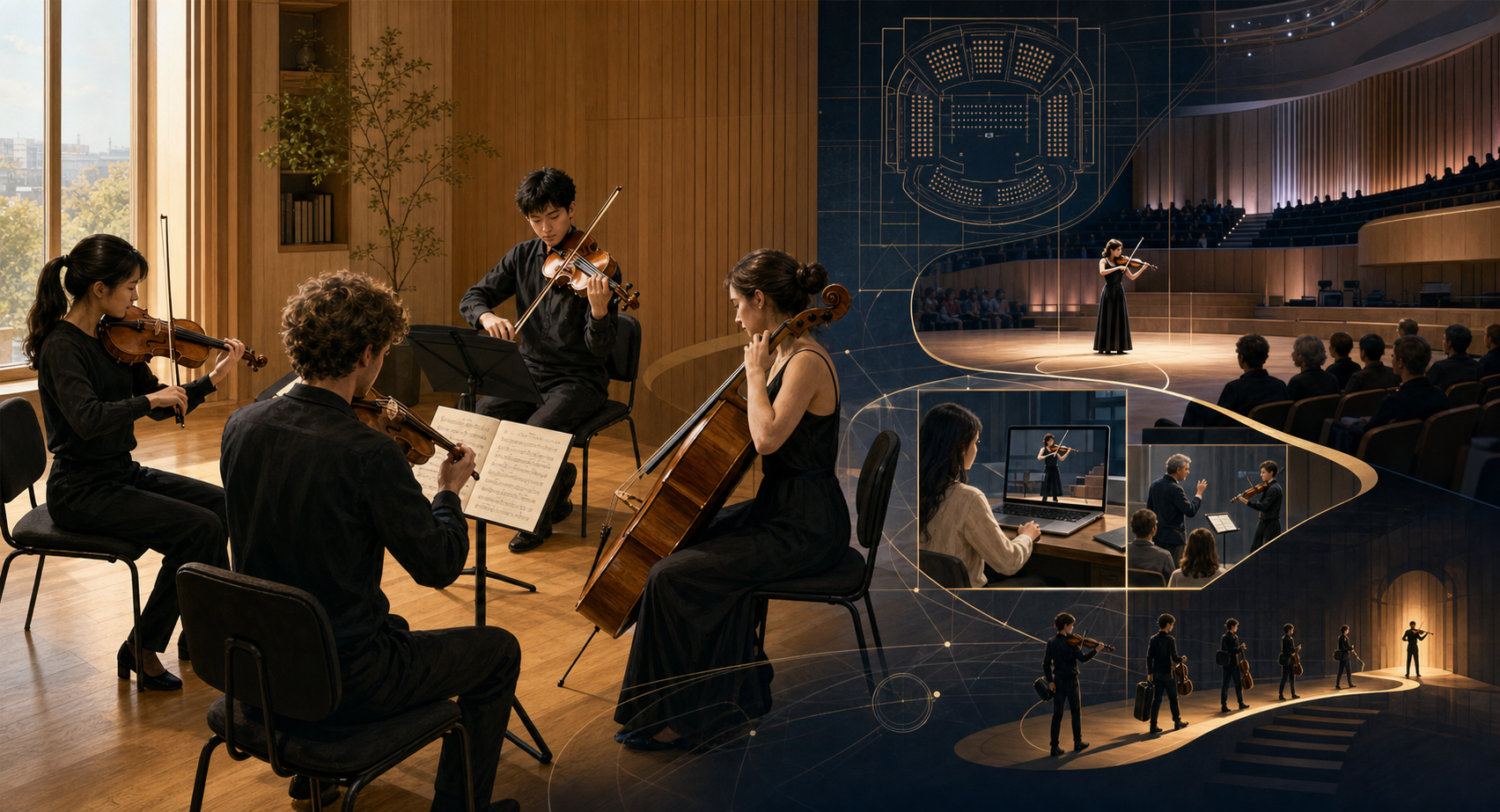
Why is Indianapolis's public schedule a bigger story than a competition calendar?
Because the official 2026 event schedule reads like live-event architecture, not insider paperwork. The Indianapolis competition has already mapped opening ceremonies, preliminaries, semi-finals, finals, and the gala awards ceremony across Newfields, the Basile Theater, the Schrott Center, Hilbert Circle Theatre, and the Scottish Rite Cathedral Theater. Just as important, the semi-final round includes the world premiere of Jessie Montgomery's Rhapsody No. 3 for Solo Violin. That detail matters. It keeps a major violin competition tied to living repertoire instead of only re-testing the same standard canon. For presenters and fans, the public schedule makes the event legible months in advance. For young players, it shows that the modern path is not only about jury approval. It is about how an institution stages you in front of a real city, real rooms, and a real sequence of audience-facing moments.
Tanya's performer take: violin competitions matter most when they become public culture, not sealed prestige. If you are a performer, manager, or organizer, the question is no longer just who wins. It is whether the event teaches the audience how to follow the journey.
What is David Garrett's late-July rollout showing crossover violinists?
That crossover scale still depends on clarity and repetition. Garrett's official live page puts the next three dates in plain view: Füssen on July 31, Salem on August 1, and Ludwigsburg on August 2, all framed as Millennium Symphony open-air crossover shows with band and orchestra. That matters by itself because it shows a violin-led outdoor run that is being sold like a major summer route, not a one-off gala. But the larger move becomes clearer when you place it next to Deutsche Grammophon's June 26 announcement for the album Immortal, which set an October 9 release date and positioned the first single, "Puccini: Nessun Dorma," as the opening shot. For electric violinists and crossover artists, that pairing is useful. The live show is not floating alone. It is part of a longer release story.
Tanya's performer take: world-class crossover does not mean random scale. It means routing, repertoire, visuals, and release timing all point in the same direction so the audience understands the project before the first note lands.
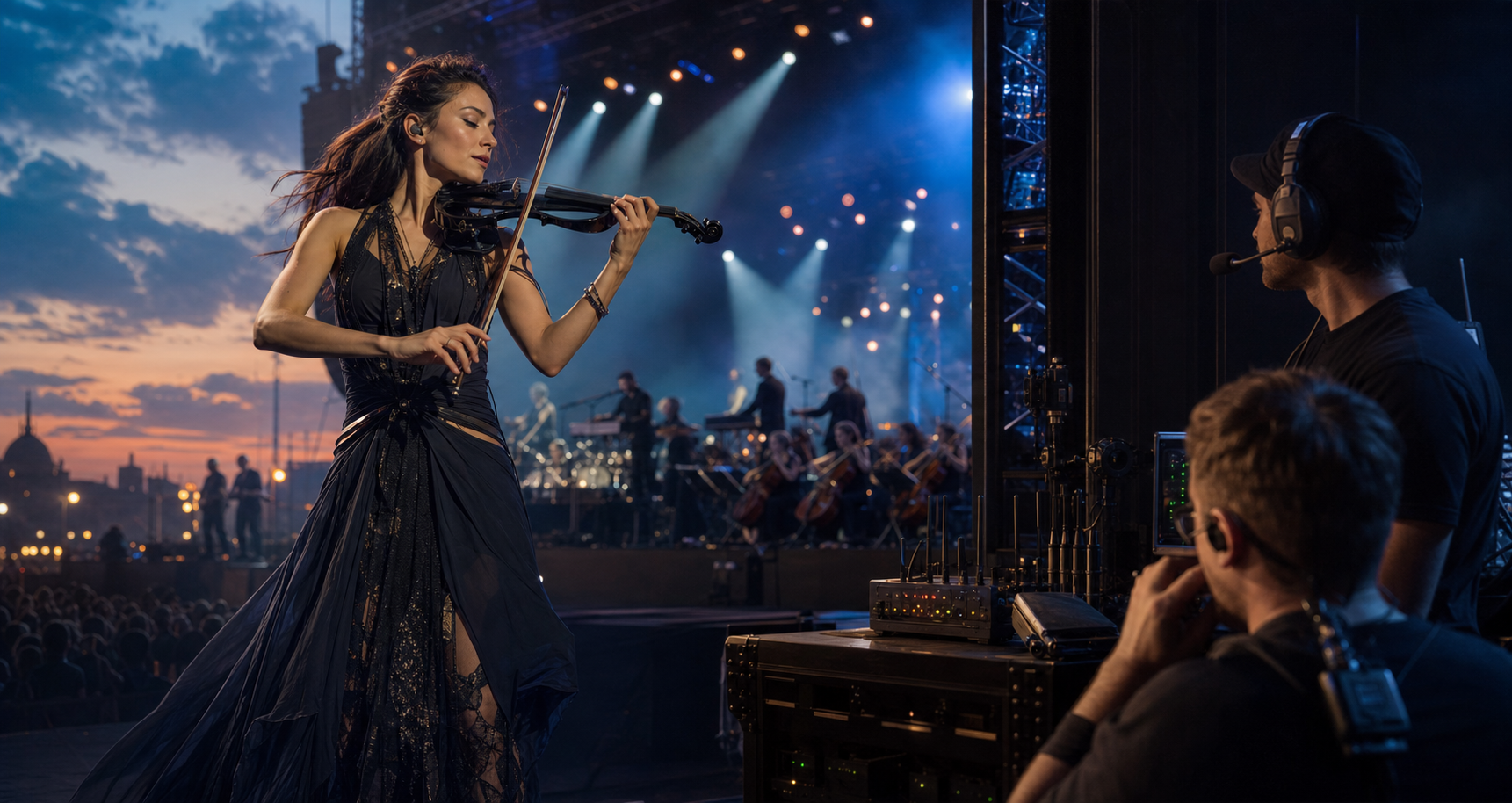
Why should performers and planners care about Sennheiser's Spectera update?
Because better stage communication is performance infrastructure, not backstage trivia. In its July 15 Spectera update, Sennheiser added a Command Button plus firmware 1.4 features that support push-to-talk, push-to-mute, deeper monitoring through the Spectera WebUI, and full control through the SoundBase app. The company specifically calls out RSSI, link quality, battery levels, interference status, and audio levels for microphones and IEMs. That is highly relevant to violin and electric violin performance, especially when a show depends on fast coordination between player, monitor engineer, musical director, and stage crew. The better the communication layer, the less energy gets wasted solving preventable problems in the middle of a complex set.
Tanya's performer take: if you play amplified violin, hybrid sets, or tightly scripted live shows, you should pay attention to talkback and monitoring workflow with the same seriousness you give pedals, wedges, or wireless packs. Cleaner communication is part of cleaner performance.
What should violinists, electric violinists, planners, and fans watch next?
- Watch which festivals make concert, livestream, and master class feel like one product, because that is where audience loyalty is being built now.
- Track competitions that publish a clear room-by-room journey and add new commissioned music, because that is where violin stays culturally alive rather than merely ceremonial.
- Study crossover artists who connect release timing to live routing, because that discipline matters more than genre labels.
- Do not treat crew communication as secondary tech. On modern violin stages, talkback and monitoring workflow directly affect performance confidence.