News · 2026-09-04
Violin News Roundup: Premio Paganini Opens a Live-Electronics Lane, Kevin Zhu Starts in China, Florence Puts Luthiers on Stage, and HIMARI Turns Debut Into Demand
As of Friday, September 4, 2026, the strongest violin signal is that the field is becoming more international and less siloed at the same time. Premio Paganini has just opened a new application cycle with a live-electronics semifinal element, Kevin Zhu begins a five-city China recital tour tonight, Florence turns maker culture into a public concert story through the Tuscan Luthier Festival, and HIMARI is turning a debut release into sold-out demand. For performers, presenters, and fans, that combination matters more than one isolated headline.
Follow Tanya Strings on Google
Add the site as a preferred source to see more new violin posts from Tanya Strings in Google.

Why is Premio Paganini the sharpest competition signal of the week?
Because the fresh application window says a lot about where top-tier violin culture is heading. In its September 1 update, Premio Paganini says applications are now open for the 59th edition, with submissions accepted through December 1, 2026, ahead of the main competition in Genoa on October 11 to 24, 2027. The structure is already global: video preselection first, then live auditions in Tokyo, Shanghai, Berlin, Genoa, and New York. The most interesting detail is not logistical. It is artistic. The competition says one semifinal highlight will be a specially commissioned work for violin and live electronics by Matteo Franceschini. That is a serious message from a legacy institution. Competition prestige is no longer being protected by pretending contemporary language or stage experimentation does not belong in the room.
Tanya’s performer take: electric violinists and crossover artists should notice this immediately. When a historic competition opens a live-electronics lane, it signals that violin authority is expanding, not weakening.

What does Kevin Zhu’s China run say about recital demand right now?
It says audiences still respond to focused violin identity, not only orchestral brand power. Kevin Zhu’s official site lists a China recital tour running from September 4 to 13 in Shanghai, Xi’an, Chengdu, Chongqing, and Tianjin, with Thomas Hoppe at the piano. Hoppe’s own concert calendar fills in the program: Brahms Hungarian Dances, Grieg’s Third Sonata, Strauss’s Rosenkavalier Waltz, and Strauss’s Violin Sonata in E-flat major. That is not a safe background-music package. It is repertoire that asks for color, stamina, and personality. Zhu’s biography also matters here: he won First Prize at the Paganini Competition at age 17, and now he is using that credibility in recital format rather than waiting for the next concerto headline to define the season. That is a useful model for violinists who want a career with more control over narrative and venue fit.
Tanya’s performer take: a strong recital program is still one of the clearest ways to prove artistic range. If you can hold a room with repertoire and point of view, you are building something deeper than a single guest-soloist slot.
Why does Florence’s Tuscan Luthier Festival matter beyond tourism copy?
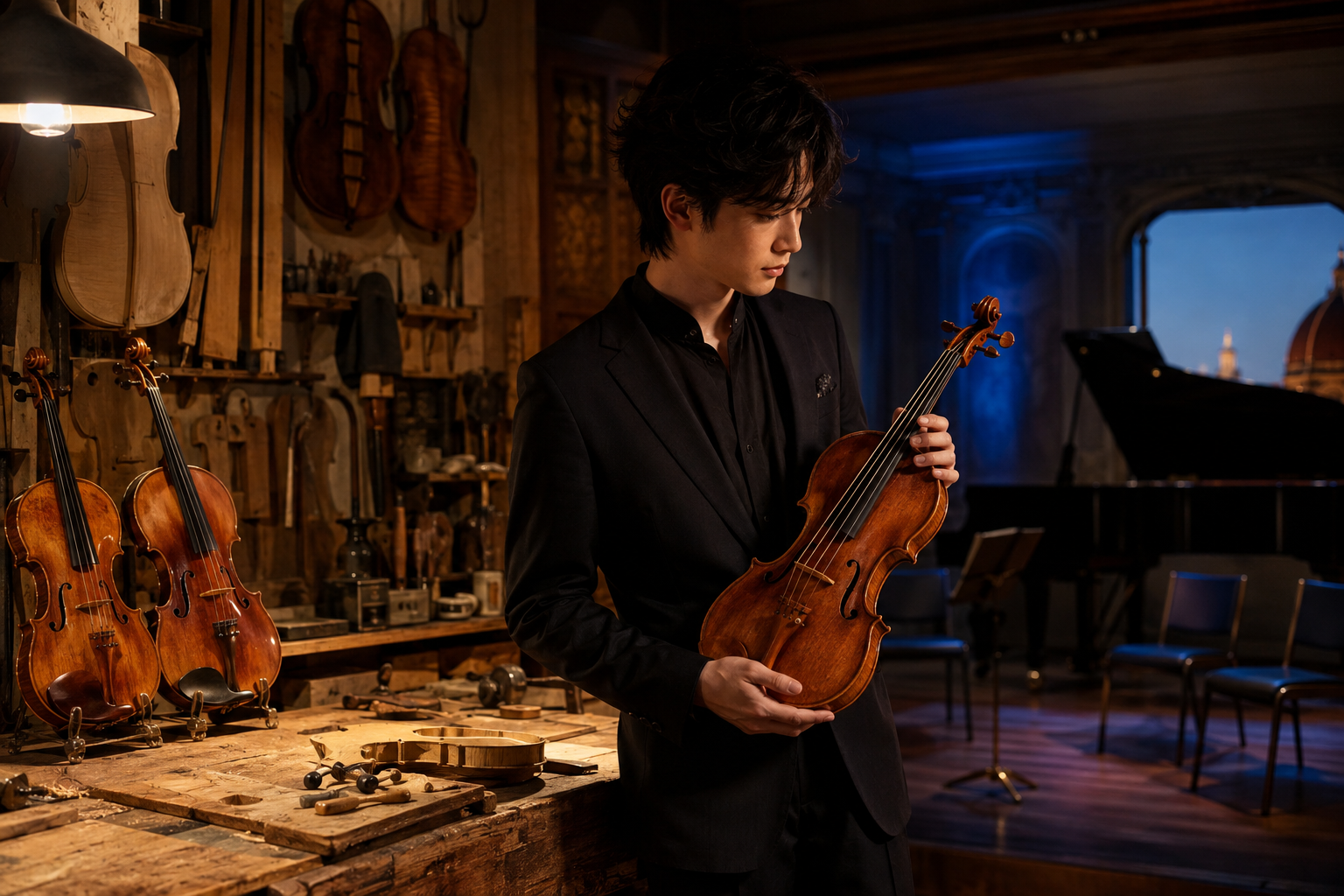
Because it treats instrument making as part of the concert story instead of hiding it backstage. The official Florence event page says the 10th Tuscan Luthier Festival runs from September 5 to 7 at Santo Stefano al Ponte. The first two nights feature the Florentine Chamber Orchestra under Giovan Battista Varoli in Strauss, Schumann, and Tchaikovsky, with first violinist Marco Lorenzini performing on an instrument made by Giuseppe Stefanini in 1974. On September 7, Trio Florenzia plays Schubert and Mozart, while violist Leonardo Bartali uses a 1973 viola by Luciano Sderci. That framing is smart. Audiences are not only hearing repertoire; they are being invited to connect sound with the hands, materials, and regional craft traditions behind it. In a market full of generic event language, that is a much stronger identity move.
Tanya’s performer take: performers do better when instrument culture feels visible and alive. It gives a concert more texture, gives presenters a more memorable story, and reminds fans that violin sound is built as well as played.
How is HIMARI turning a debut release into a bigger stage story?
By making the release feel like the center of a broader demand curve. Universal Music Japan’s artist page shows that on August 28 a new pre-release track from Debut, Chopin’s Nocturne in the Heifetz arrangement, began streaming, while the album itself is set for September 25. The earlier album announcement adds the larger context: the record includes a live Berliner Philharmoniker performance of Wieniawski’s First Violin Concerto with Sebastian Weigle, plus studio sessions with pianist Chelsea Wang, and even highlights the use of the 1717 Stradivarius “Hamma” and the 1732 Guarneri del Gesù “Ferni” across different repertoire. Then the official HIMARI concert page raises the temperature further. Her late-September London Symphony Orchestra Japan dates are already marked sold out, and her December recital tour is sold out in Nagoya, Osaka, Sapporo, and Tokyo before the Taiwan dates. That is not just youth hype. It is a sign that recording, star-orchestra credibility, and direct ticket demand are reinforcing one another quickly.
Tanya’s performer take: the strongest release strategies do not stop at streaming. They turn the album into proof of artistic identity, then carry that identity straight into rooms people are already willing to fill.
What should violinists, presenters, and music fans watch next?
- Watch competitions that expand repertoire language instead of guarding a frozen definition of seriousness.
- Watch recital tours closely, because they reveal which artists can carry a season with programming rather than only with prestige branding.
- Watch festivals that put maker culture in public view, since craft is becoming part of the audience story again.
- Watch how young violin stars connect release strategy, sold-out dates, and institutional scale into one clear narrative.