News · 2026-09-05
Violin News Roundup: Enescu Goes Live, Seven Strings Meet Jazz, Jozef Nadj Opens the Room, and Hilary Hahn Heads to Berlin
As of Saturday, September 5, 2026, violin news is stretching from exacting solo rounds to electric improvisation and a major festival stage. The George Enescu International Competition’s violin first round is under way in Bucharest; Eric DeLente brings a seven-string electric violin into a live jazz exchange tonight; Jozef Nadj follows with a free Berklee concert on September 8; and Hilary Hahn joins the Vienna Philharmonic at Musikfest Berlin on September 9. The useful story is the range itself: serious violin careers now move between judged repertoire, amplified spontaneity, accessible rooms, and global orchestral visibility without needing to flatten those identities into one style.
What changes now that the Enescu violin rounds are live?
The calendar has become performance rather than anticipation. According to the official competition schedule, violinists entered the first round on September 4 and continue through September 6. The second round follows September 8–9, the semifinal September 11, and the final September 13. The opening requirement is revealing: a substantial Bach movement, a complete Ysaÿe solo sonata, and a Romanian work selected from Enescu, Porumbescu, or Capoianu. That combination tests architecture, individual voice, and cultural context before competitors reach concerto scale. For viewers and presenters, the next week offers a compressed look at how young artists manage contrast and pressure.
Tanya’s performer take: competitions matter most when we watch beyond rankings. Bow control after a difficult solo work, pacing between styles, and recovery in real time reveal the stage intelligence that transfers directly to professional concerts.
Why is tonight’s seven-string electric violin set worth watching?
The Frederick Jazz Society lists drummer Ronnie Burrage with special guest Eric DeLente for September 5. Its description puts DeLente’s seven-string electric violin at the center: the extended range can reach bass territory, keep the singing violin register, and move toward guitar-like color. More important, the evening is framed as live discovery between two responsive musicians, not as a novelty demonstration. That is exactly where extended-range electric violin earns credibility. The extra strings are useful only when phrasing, listening, and arrangement turn them into musical choices.
Tanya’s performer take: range is not the headline by itself. A seven-string instrument becomes compelling when the player can leave space for drums, switch register with purpose, and make technology disappear into the conversation.
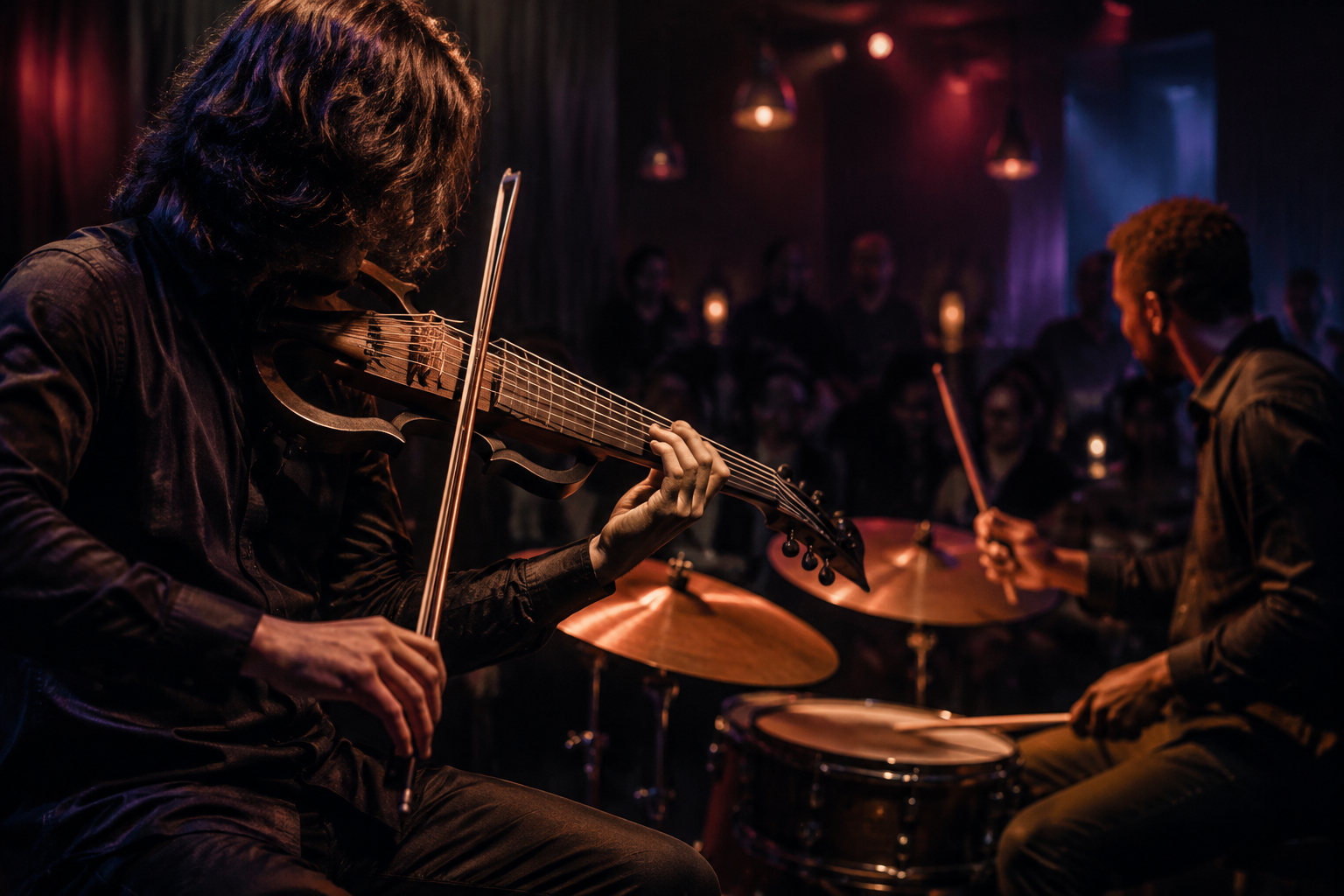
How does Jozef Nadj make electric violin access feel practical?
Berklee’s official event page announces Jozef Nadj and the Groove Machine at David Friend Recital Hall on Tuesday, September 8. Admission is free, and the program combines Nadj’s original compositions with standards. That simple setup carries a strong industry lesson: a distinctive electric-violin identity can be introduced through an accessible room and familiar musical reference points, then expanded through original work. Free admission also lowers the risk for listeners who may not already follow electric strings. For artists and event planners, this is smart audience development rather than a discount on artistic value.
Tanya’s performer take: an open door works when the show behind it is specific. Originals establish voice; standards give the audience a bridge; a band proves the violin belongs inside a full groove rather than floating above it.
What does Hilary Hahn’s Berlin date add to the picture?
At the largest institutional scale, the Berliner Philharmoniker calendar places Hilary Hahn with the Vienna Philharmonic and conductor Tugan Sokhiev on September 9 during Musikfest Berlin. Hahn plays Dvořák’s Violin Concerto, followed by excerpts from Prokofiev’s Romeo and Juliet. The pairing is useful: Dvořák asks a soloist to balance folk-inflected lift with long orchestral thought, while the Prokofiev keeps dance and drama in the room after the concerto. This is a prestige booking, but it is also a programming reminder that rhythmic identity can connect a solo feature to the rest of an evening.
Tanya’s performer take: world-class presentation is not only about the name above the title. The strongest programs let the soloist’s rhythmic and tonal world continue through the whole concert, giving audiences one memorable arc.
What should performers and presenters carry into next week?
- Follow the Enescu rounds for performance decisions, not only the final list.
- Treat extended range as arranging vocabulary, never as a substitute for listening.
- Use accessible concerts to introduce a strong electric-violin identity to new audiences.
- Build programs whose rhythmic character survives beyond the solo showcase.