Violin News: Chloe Chua, Joshua Bell and Haskovo
This October 13 violin roundup follows three routes that put performance in front of new audiences. The Singapore Symphony Orchestra opens its seven-city China tour today with violinist Chloe Chua playing Mendelssohn in Shanghai. Joshua Bell and the Academy of St Martin in the Fields begin an Asia tour in Taipei with Dvořák’s Violin Concerto in the programme. Closer to home, Haskovo will host the 2026 Prof. Nedyalka Simeonova International Violin Competition from October 16 to 18. Tanya’s performer take: travel is not merely a diary of dates; it is a test of whether artistic identity, technical preparation and production detail can remain clear in every room.

Original AI-generated editorial image for Tanya Strings.
What is Chloe Chua playing on the Singapore Symphony’s China tour?
The Singapore Symphony Orchestra begins its China tour at Jaguar Shanghai Symphony Hall on October 13 and continues through October 25. Music Director Hannu Lintu leads seven dates in Shanghai, Wuhan, Beijing, Changsha, Guangzhou, Shenzhen and Xiamen. The tour has two programmes, so listeners should check the relevant city listing rather than assume every soloist appears every night.
Chloe Chua is the violin soloist in the first programme, which couples Wang Chenwei’s The Sisters’ Islands with Mendelssohn’s Violin Concerto and Mahler’s First Symphony. The official schedule places her in Shanghai, Changsha, Guangzhou, Shenzhen and Xiamen. A second programme brings violinist Chua together with violist He Ziyu for Mozart’s Sinfonia Concertante, alongside the same orchestra and conductor, in Wuhan and Beijing.
Why does this itinerary matter beyond the concert listing?
It is a useful reminder that the same artist can carry more than one role across a tour: concerto soloist in one city, chamber-like partner within an orchestral frame in another. That shifts the musical conversation as well as the logistics. For a performer, the preparation is not only about having repertoire secure. It is about making the sound, pacing and presence legible to a new audience night after night.
- Confirm the exact programme, stage layout and rehearsal allocation for every date.
- Keep one dependable travel-ready routine for warm-up, instrument checks and recovery.
- Let short creator content show the human scale of the route: a soundcheck, a hall or a musical detail—not only the airport.
Tanya’s performer take: an international tour looks polished because the details are repeatable. The audience may see one special evening; the artist needs a reliable process behind all seven.
Where is Joshua Bell taking Dvořák this week?
The Academy of St Martin in the Fields lists an Asia tour with Music Director Joshua Bell from October 13 to 21. It starts in Taipei, then travels to Chengdu, Beijing, Shanghai and Shenzhen. The announced programme includes Dvořák’s Violin Concerto and Mozart’s Symphony No. 41, the “Jupiter.”
For a violin audience, the value of this news is not simply the celebrity name. A touring soloist-director format places musical leadership visibly inside the performance: the same person shapes the violin line and the orchestra’s collective energy. That can make familiar repertoire feel immediate, while asking for exceptionally clear communication from the platform.
Event planners can take a practical cue from this. Programme notes, social clips and audience messaging should tell people what makes the encounter distinctive before the first note: here, an acclaimed violinist is appearing with the chamber orchestra he leads artistically. A precise invitation beats generic “world-class evening” copy every time.
What is happening in Haskovo this weekend?
Haskovo Municipality has scheduled its Prof. Nedyalka Simeonova International Violin Competition for October 16–18, within the 51st Prof. Nedyalka Simeonova Music Days. The municipality has published the participation terms and application material in Bulgarian and English.
The timing is a welcome local marker in a week full of large international routes. Competitions create an audience-facing reason to hear emerging players in concentrated form, while the surrounding festival gives the event a civic setting rather than treating it as a closed test. For young artists, that means presenting musical ideas under pressure; for listeners, it is a chance to encounter developing voices before their paths become predictable.
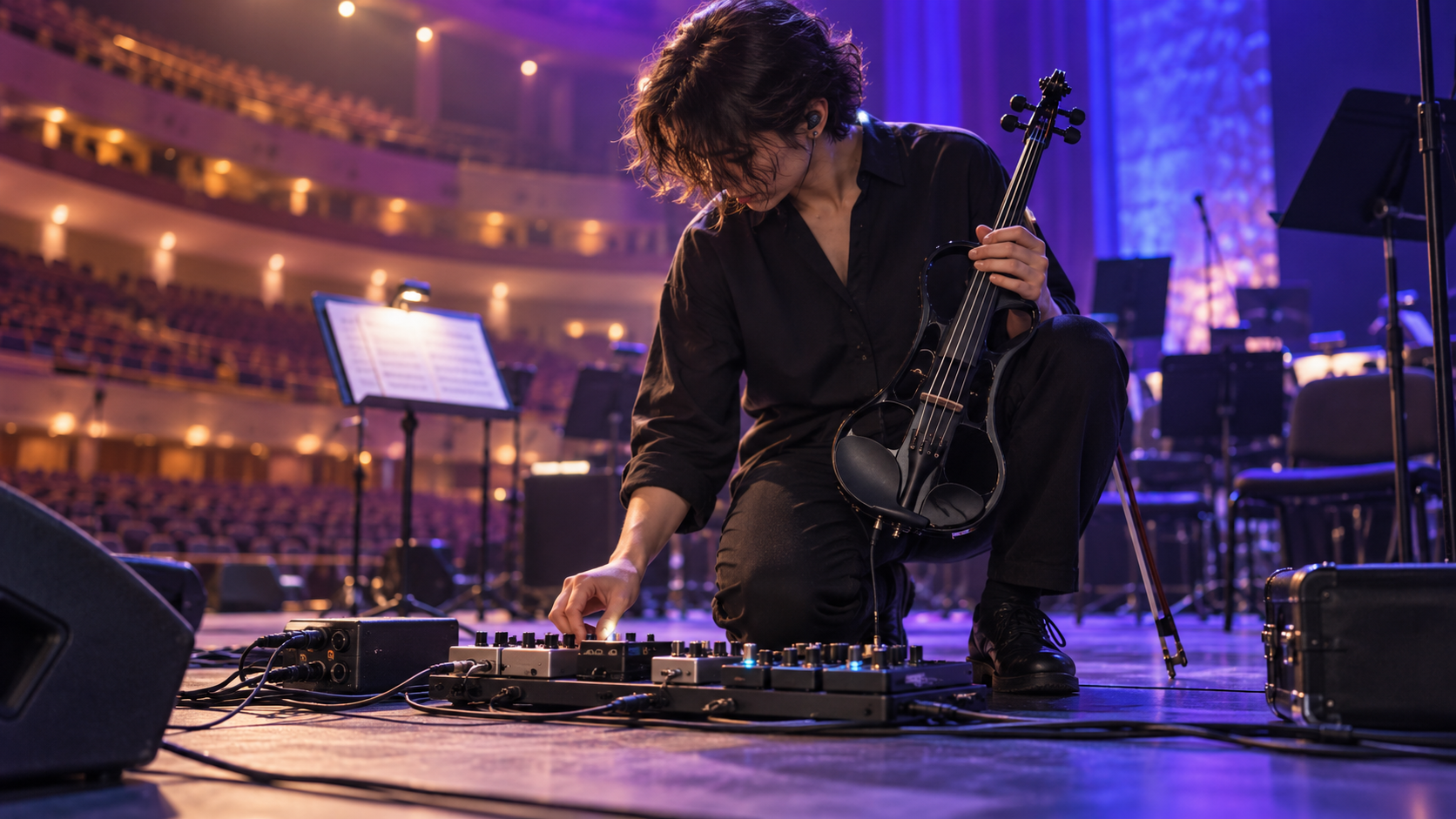
Original AI-generated editorial image for Tanya Strings.
What should performers and music fans follow next?
Follow the SSO’s city-by-city programme details through October 25, watch the Academy of St Martin in the Fields tour through October 21, and look to Haskovo from Friday as the competition begins. The common thread is mobility with purpose: a violin can move between concerto tradition, collaborative leadership and a young-artist platform without losing its voice. For Tanya Strings, that is also the promise of the electric violin stage—bold sound and visual energy work best when they serve a performance people can genuinely connect with.