Violin News: Batiashvili, Fischer and Electric Sound
Today’s violin news connects chamber-music detail, concerto-scale focus and a clear electric signal. Lisa Batiashvili, Gautier Capuçon and Jean-Yves Thibaudet arrive at Montréal’s Bourgie Hall for two October 21–22 trio dates; Julia Fischer plays Brahms with the London Philharmonic Orchestra at Royal Festival Hall tonight; and the BBC Scottish Symphony Orchestra has announced Enrico Chapela’s Antiphaser, a concerto for electric violin and orchestra, for Glasgow on October 29. Tanya’s performer view: each item is about identity. Great events make the relationship between musicians, repertoire and sound feel deliberate from the first note.
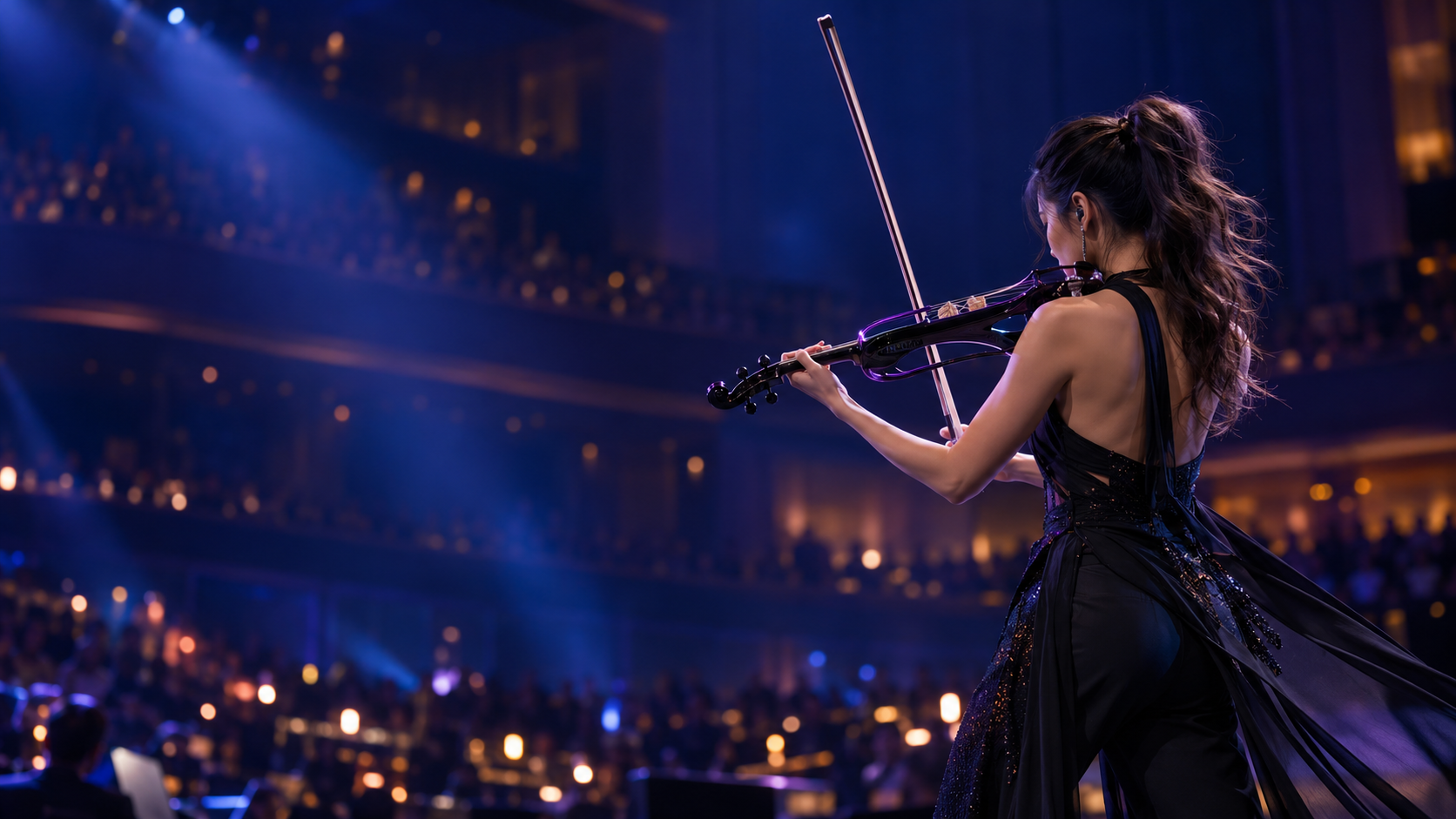
Original AI-generated editorial image for Tanya Strings.
What can Montréal learn from a touring piano trio?
Lisa Batiashvili’s official schedule lists October 21 and 22 at Bourgie Hall in Montréal with cellist Gautier Capuçon and pianist Jean-Yves Thibaudet. Their programme brings together Shostakovich’s First Piano Trio, Debussy’s Piano Trio and Dvořák’s Third. The trio reaches Montréal after October stops in California, Chicago and Cleveland, then continues to New York on October 24.
That itinerary matters because piano-trio touring is a test of repeatable listening. Three highly individual players must make a single pulse feel fresh night after night, in halls with different acoustics and pianos. For a violinist, it is a reminder that profile is earned through attention: a phrase that leaves room for the cello or lets the piano’s colour lead can read as power, not retreat.
Why should creators and presenters care about that chemistry?
A short video or concert trailer need not flatten chamber music into three solo portraits. It can show the cue, the shared breath and the handoff. Those details give audiences a reason to listen beyond star names.
- Film rehearsals from angles that reveal eye contact and timing.
- Describe the programme’s emotional route, not only its composers.
- Leave enough stage and soundcheck time for ensemble balance.
Tanya’s performer take: collaboration is compelling content when the camera can see musicians actively listening.
Why does Julia Fischer’s Brahms night still feel current?
The London Philharmonic Orchestra’s season brochure places Julia Fischer with conductor Edward Gardner at Royal Festival Hall on October 21 for Brahms’s Violin Concerto, followed by Tchaikovsky’s Manfred Symphony. That pairing gives the soloist a concentrated opening statement before the orchestra expands into a large dramatic canvas.
For an event planner, a familiar concerto is not a reason to make generic marketing. Brahms gives a venue a strong story about lyricism, stamina and a soloist’s relationship to an orchestra. For performers, it is a useful lesson in scale: the opening needs patience, the big arrival needs weight, and every detail has to survive a hall much larger than a rehearsal room.
Electric violinists can take the same idea into crossover work. The gain structure, monitor mix and effects choices should serve the musical arc. A delay may widen a climax, but it cannot replace the discipline that makes a long phrase point somewhere.
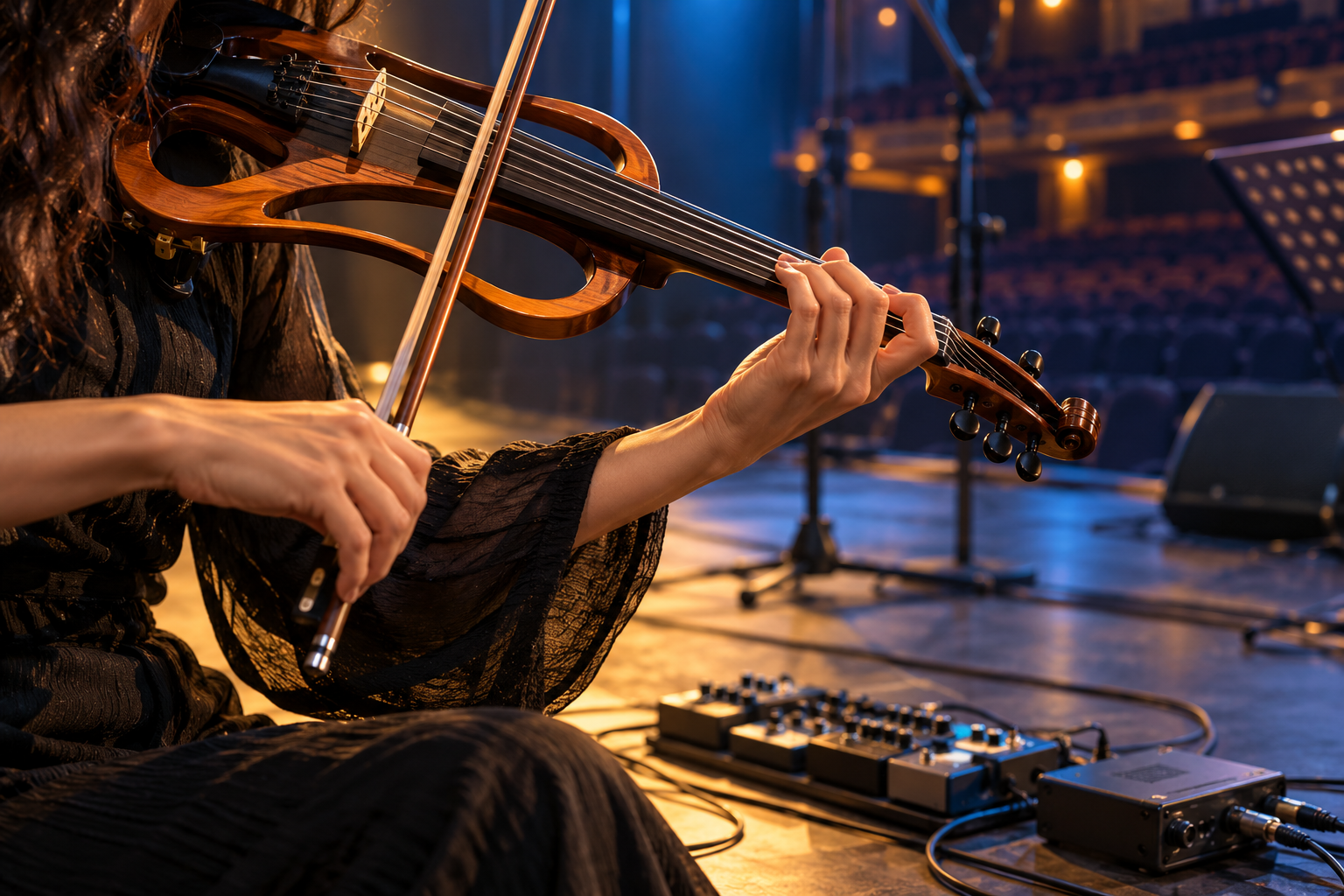
Original AI-generated editorial image for Tanya Strings.
What does an electric violin concerto change?
The BBC Scottish Symphony Orchestra event listing schedules Enrico Chapela’s Antiphaser, described as a BBC co-commission for electric violin and orchestra, at Glasgow City Halls on October 29. Chloë Hanslip is listed as soloist with Mihhail Gerts conducting; the programme also includes Arvo Pärt’s Swansong and Eduard Tubin’s Sixth Symphony.
An electric violin concerto matters because it frames amplification as orchestral colour rather than a novelty break. It asks the sound team, composer and soloist to agree on a language: where the instrument sits in the spectrum, how it projects rhythmically, and when its signal should sound intimate or immense. Those questions are familiar to a world-class electric violin performer, but they become especially visible when an orchestra is the partner.
What should audiences take from this week’s news?
Batiashvili’s trio, Fischer’s concerto and Chapela’s electric work point to three valid ways of building presence: listening across a small ensemble, carrying a vast traditional form and designing a new amplified voice. Tanya Strings approaches the stage as a world-class electric violin performer and content creator, where every concert needs a musical reason, a visual point of view and a sound plan that honours both. For music fans and bookers, that is the useful filter: choose the events that make their artistic purpose audible.