Violin News: Firebird, Mira Wang and Inmo Yang
This week’s violin news is less about spectacle than choices that make a programme memorable. In London, Yury Revich will lead a Firebird-themed evening from the violin, placing Max Richter’s reimagined Four Seasons beside narration and new music. In New York, Mira Wang is set to bring Ignatz Waghalter’s Violin Concerto to Carnegie Hall after the work’s U.S. premiere at Bard. And at the Barbican, Inmo Yang will play Bartók’s First Violin Concerto with the BBC Symphony Orchestra. Tanya’s performer take: the strongest live concepts give the violin a clear job in the story, then build the room, repertoire and communication around it.
How does Yury Revich’s Firebird turn a violin recital into an event?
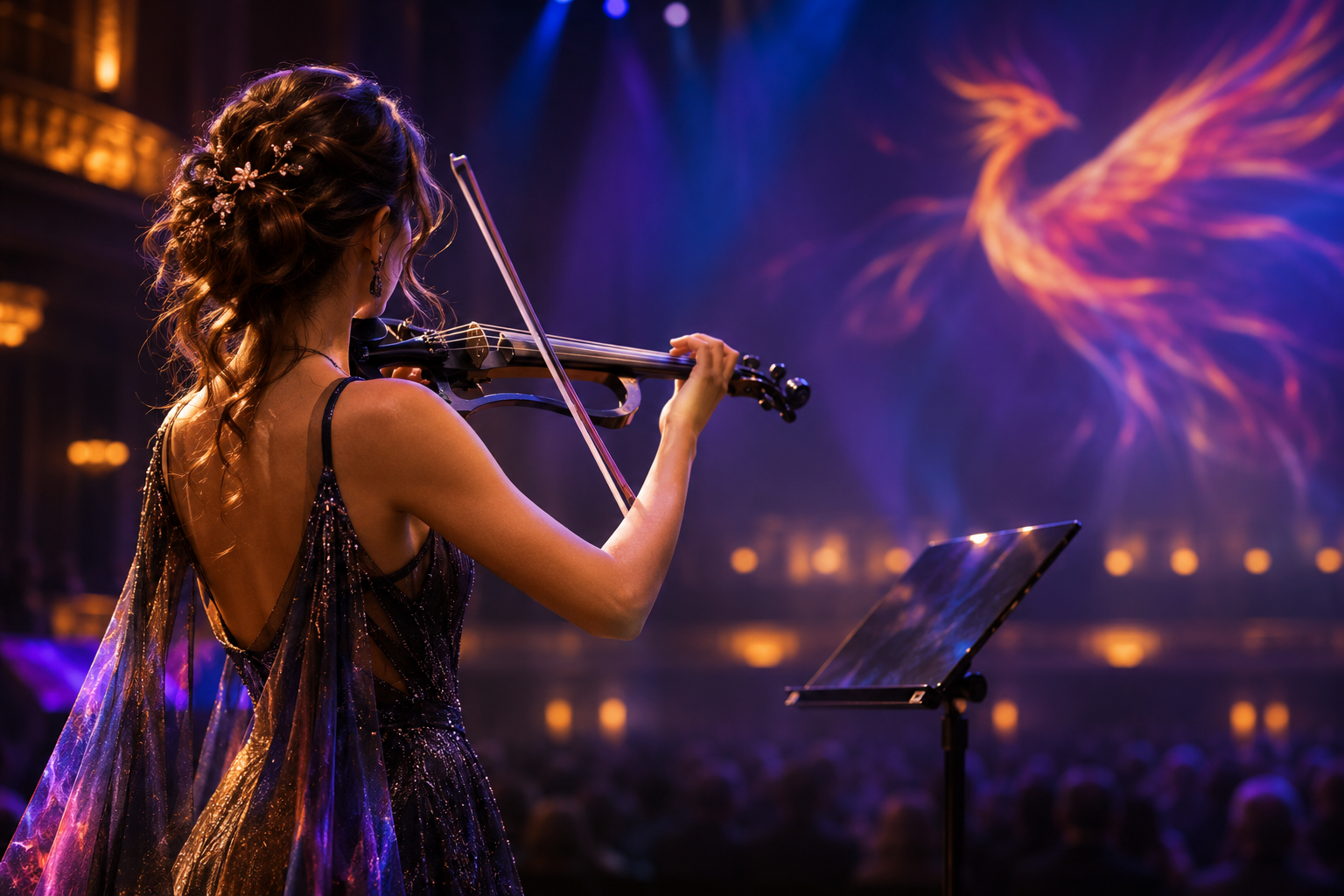
On November 17, violinist and director Yury Revich brings his Festival Nights series to St George’s Hanover Square in London. The official Firebird listing puts Max Richter’s version of Vivaldi’s Four Seasons at the centre, with actor Tom Prior reading Vivaldi’s sonnets. Tartini’s Devil’s Trill Sonata and Revich’s own works, Cascade and The Ocean, complete the programme; Revich also leads the chamber-sized London Firebird Orchestra from the violin.
The idea makes the concert’s shape easy to understand before anyone takes a seat. Nature, narrative and virtuosic violin become distinct entry points within one frame.
- For performers: decide what the audience should be able to describe in one sentence after the show.
- For presenters: give a cross-disciplinary element, such as spoken text or projection, a musical reason to be there.
- For content creators: film one transition that shows how the concept changes the atmosphere, not only the fastest passage.
Tanya’s take: electric violin shows can borrow this clarity. Effects, tracks and lighting earn their place when they sharpen the musical scene instead of competing with it.
Why is Mira Wang’s Waghalter concerto worth following?
The Orchestra Now’s recently published November announcement places Chinese-born violinist Mira Wang at the centre of a programme led by JoAnn Falletta. At the Fisher Center on November 14–15 and Carnegie Hall on November 17, the ensemble will present the U.S. premiere of Ignatz Waghalter’s Violin Concerto in A major alongside music by Lazare Saminsky, Louis Gruenberg and Ernst Toch. Bard’s announcement frames the concerts around Jewish émigré composers writing during the Jazz Age.
That context matters. “Rediscovered” is not a genre by itself; a concert needs a reason listeners should care now. Here, the violin concerto becomes one voice in a larger programme about musicians whose work travelled, changed countries and fell out of the usual repertoire. For fans, it is a rare chance to hear a substantial violin work in a clear historical setting. For planners, it shows that unfamiliar music sells more honestly when the curatorial idea is specific.
What can artists learn from a rediscovery?
New repertoire needs a short explanation, reliable credits and a sample that lets the music speak. One sentence can give a listener confidence to press play or buy a ticket.
What makes Inmo Yang’s Bartók date a useful concert-hall signal?
The Barbican’s 2026–27 season announcement lists Inmo Yang with the BBC Symphony Orchestra and conductor Sakari Oramo on November 10 for Bartók’s First Violin Concerto, alongside Enescu and Brahms. That placing invites listeners to hear the concerto as part of a conversation between sharply individual composers rather than as an isolated solo slot.
Bartók’s First Concerto demands concentrated lyricism and a strong sense of line. The lesson travels beyond the symphonic hall: programme contrast is production. An electric violin set can place a singing moment beside a rhythmic loop or cinematic build, but the emotional route should stay obvious.
What should performers and music fans watch next?
These three dates share a practical lesson: make the violin’s role legible. Revich builds an evening around a visual and literary idea; Wang carries a neglected concerto within a precise historical programme; Yang’s Bartók is placed in orchestral contrast. Tanya Strings approaches world-class electric violin performance and creator work the same way: a distinct sound, dependable live setup and a story listeners can follow in the room and online. Gear supports the message.